Food fuels your workday (not just your workout)!


(Reading time: 6 min total / 2 min with quick takeaways)
Hey, FTWer!
What’s for lunch?
If we worked together, I’d ask you this most days—mostly because I’m really into food. In my senior year, I got the Foods Award, and the teacher introduced me by saying, “I’ve never had a student get so excited about food.” 😂 In other words, when I decided to get my nutrition coaching certification, no one said, "but why?"
Nutrition is vital to the health of our bodies, to our fitness—we know that. But sometimes I wonder if we forget how intimately linked those benefits are to our ability to be great at our jobs. Even if you don't have any fancy fitness goals these days, eating "well" matters.
So today my inspo is coming at you in the form of how food positively impacts our busy working lives. The “Fit” in Fit to Work and Loki Fit isn’t just short for “Fitness.” It’s about fitting health habits of all sorts into our day-to-day so we can continue to fit in (and be capable of) all the stuff we want to do—like travel, and do puzzles, and sleep.
To keep it simple(ish), I'm sticking to the major building blocks of our diet: macronutrients. In addition to why they matter and what they consist of, I'll give you a low-key idea of quantities to aim for. Because percentages and calories can get convoluted and are very individualized, nutrition coaches often reference your unique hand to identify how much of each of these Big Three we want to aim for:
- Your palm for protein,
- Your cupped hand for carbs,
- Your thumb for fats,
- (Also, your fist for veggies, but for today let's just say eat more veggies 😄)
Let’s dig in. And if you're tight on time today, scan through for the green callouts to get the gist without all the extras!
Protein
Proteins are instrumental in pretty well every function our bodies perform. When it comes to strength training, they play a big role in muscle repair, which is why trainers are always telling you to get some protein in shortly after a workout.
In terms of fueling the workday, the building blocks of protein—amino acids—are part of many of the chemical reactions in the brain, translating to improved cognition. Studies suggest sufficient protein can help with verbal fluency and recall, for instance. For the long term, there’s evidence that getting enough protein can help prevent cognitive decline as we age.
How much protein do you need? You can probably ignore the influencers saying every meal needs 40 grams or more (assuming you’re not an elite marathoner or a powerlifter). Shoot for 1 to 2 of your palms at every meal.
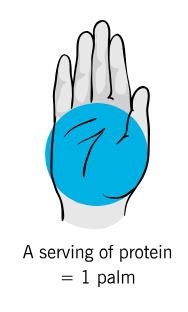
And get creative! There’s a whole world out there beyond chicken breast. Play with legumes and quinoa (also great carbs), tofu or tempeh, and fish. Don’t forget that foods we eat regularly, like pasta, have more protein than you might think.
Carbohydrates
Don’t fear the carb! It’s the macronutrient that provides us with energy (the glucose in it, specifically), and if you’ve been feeling sluggish lately, it's the first thing I’d recommend upping (especially if you’ve been trying to "curb carbs").
When it comes to desk workers, carbs are essential for mood regulation and cognitive performance, improving short- and long-term memory and enduring focus, not to mention “psychological functioning” in general. (Source)
How much? If you're not training hard for something, carbs will probably make up about 50% of your total daily calories. Yes, really! Aim for 1-2 cupped handfuls at each meal.
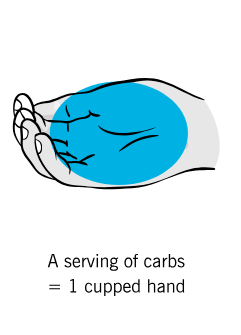
More-processed carbs are getting a bad rap lately, but quick options like pasta are absolute godsends on busy days. That said, there are lots of whole-grain options to try, like quinoa (again), oats, barley, and so on.
Fats
I remember how blown my mind was when I learned that fat is one of the primary nutrients our bodies need. Coming of age in the era of Atkins and low-fat yogurt, it’s a real adjustment for many folks Millennial-aged and older to accept that this macro is essential to keeping us alive.
Eating enough fat aids learning and memory, never mind the growth of new brain cells and other desk work-related things like eye health.
As for amount, the average person is looking at about 20-25% of total calories. Think of this as 1-2 of your thumbs at each meal (usually 1-2 Tbsps).

We want to aim primarily (but not exclusively) for unsaturated fats. For instance: compounds in avocado can protect against neurodegeneration, and chia and flax seeds help with mood regulation. Oh, and seed oils are not the enemy (we can thank certain government officials for that fearmongering).
So there you have it, or at least a very broad overview of it! Eating is so vital to our work and life performance. My wish is for everyone to discover a food-prep approach they have time for (whatever that looks like in their schedule), eat enough every day, and genuinely enjoy the process!
If any part of this raised questions, or if you want to chat about meal planning, options for specific nutrients, or anything else, hit reply or book a call. I’d love to talk through any nutrition confusion you're facing!
Remember: You’ve got this.
Til next time,
Stay strong, calm, and kind
💪💚 🧘♀️